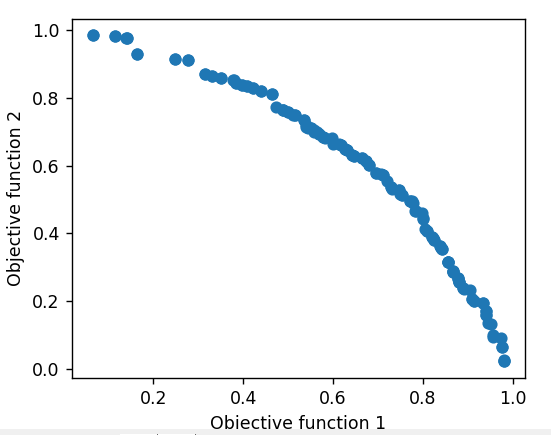
NSGA2#
Preview#
In this example we will solve a MOE problem using our library.
Setting the experiment#
First, we need to import the components we want to use in our experiment.
from eckity.creators.ga_creators.simple_vector_creator import GAVectorCreator
from eckity.multi_objective_evolution.moe_evolution import MOEvolution
from eckity.multi_objective_evolution.moe_breeder import MOEBreeder
from eckity.evaluators.simple_individual_evaluator import SimpleIndividualEvaluator
from eckity.genetic_operators.crossovers.vector_k_point_crossover import VectorKPointsCrossover
from eckity.genetic_operators.mutations.vector_random_mutation import FloatVectorUniformNPointMutation
from eckity.genetic_operators.selections.tournament_selection import TournamentSelection
from eckity.multi_objective_evolution.moe_fitness import MOEFitness
from eckity.multi_objective_evolution.moe_plot import MOEPlot
from eckity.population import Population
from eckity.statistics.minimal_print_statistics import MinimalPrintStatistics
from eckity.subpopulation import Subpopulation
from eckity.genetic_encodings.ga.float_vector import FloatVector
from eckity.multi_objective_evolution.crowding_termination_checker import CrowdingTerminationChecker
Now we can create our experiment.
Experiment goal#
in the following experiment, we will try to minimize the following objective: 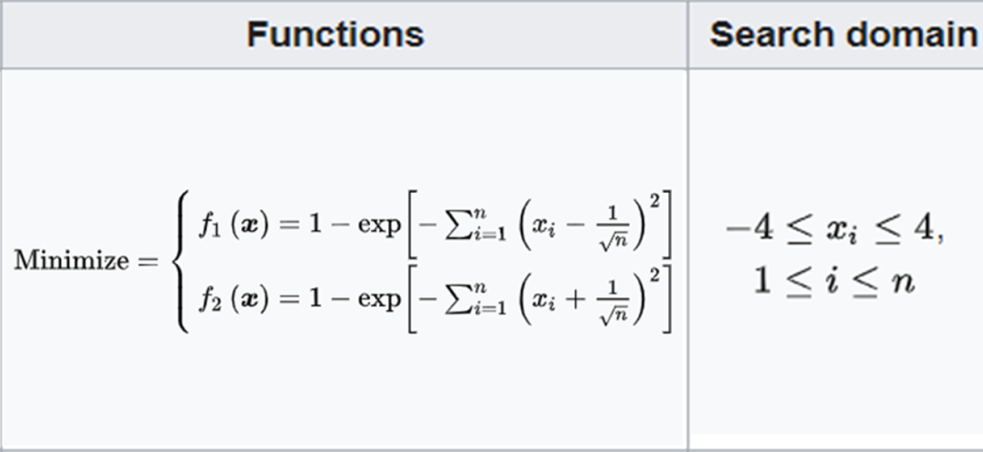
Initializing the multi-objective evolutionary algorithm#
The Evolution object is the main part of the experiment. It receives the parameters of the experiment and runs the evolutionary process:
algo = MOEvolution(
Population([Subpopulation(
creators=GAVectorCreator(length=3, bounds=(-4, 4), fitness_type=MOEFitness, vector_type=FloatVector),
population_size=150,
# user-defined fitness evaluation method
evaluator=MOEBasicTestEvaluator(),
# maximization problem (fitness is sum of values), so higher fitness is better
higher_is_better=False,
elitism_rate=1 / 300,
# genetic operators sequence to be applied in each generation
operators_sequence=[
VectorKPointsCrossover(probability=0.7, k=1),
FloatVectorUniformNPointMutation(probability=0.3, n=3)  # maybe chnge mutation
],
selection_methods=[
# (selection method, selection probability) tuple
(TournamentSelection(tournament_size=3, higher_is_better=True), 1)
]
)]),
breeder=MOEBreeder(),
max_workers=4,
max_generation=150,

termination_checker=CrowdingTerminationChecker(0.01),
statistics=MinimalPrintStatistics()
)
Let’s break down the parts and understand their meaning.
Initializing Subpopulation#
Sub-population is the object that holds the individuals, and the objects that are responsible for treating them (a Population can include a list of multiple Subpopulations but it is not needed in this case).
Creating individuals#
We have chosen to use a float vector of size 3 such that each one of its coordinates is in the range bertween -4 and 4 and since we want our algorithm to be multi-objective we are using NSGA2Fitness
algo = NSGA2Evolution(
Population([Subpopulation(
creators=GAVectorCreator(length=3, bounds=(-4, 4), fitness_type=NSGA2Fitness, vector_type=FloatVector),
Evaluating individuals#
Next, we set the parameters for evaluating the individuals. We will elaborate on this later on.
# user-defined fitness evaluation method
evaluator=NSGA2BasicTestEvaluator(),
# maximization problem (fitness is sum of values), so higher fitness is better
higher_is_better=False,
Breeding process#
Now we will set the (hyper)parameters for the breeding process.
Then, we defined the genetic operators to be applied in each generation:
1 Point Crossover with a probability of 70%
uniform point Mutation with a probability of 30%, there is a 30% chance for each individual that we will randomly pick 1 of its coordinates and change it to another float number in range (-4 to 4 in that case)
Tournament Selection with a probability of 1 and with a tournament size of 3
elitism_rate=0,
# genetic operators sequence to be applied in each generation
operators_sequence=[
VectorKPointsCrossover(probability=0.7, k=1),
FloatVectorUniformNPointMutation(probability=0.3, n=3)  # maybe chnge mutation
],
selection_methods=[
# (selection method, selection probability) tuple
(TournamentSelection(tournament_size=3, higher_is_better=True), 1)
]
)])
Now that we are done with our Subpopulation, we will finish setting the evolutionary algorithm.
We define our breeder to be the standard NSGA2 Breeder, and our max number of worker nodes to compute the fitness values is 4.
breeder=NSGA2Breeder(),
max_workers=4,
Termination condition and statistics#
We define the max number of generations (iterations). We define a termination_checker (early termination mechanism) to be with a crowding Threshold- a number that indicates the largest distance two adjacent individuals fitnesses have between them
max_generation=150,
termination_checker=CrowdingTerminationChecker(0.01),
statistics=MinimalPrintStatistics()
Evolution stage#
After setting up the evolutionary algorithm, we can finally begin the run:
    # evolve the generated initial population
    algo.evolve()
Execution stage#
After the evolve stage has finished (by exceeding the maximal number of generations), we can execute the Algorithm and show the best-of-run vector (solution) to check the evolutionary results:
    # Execute (show) the best solution
    print(algo.execute())
What is an Evaluator?#
Problem-specific fitness evaluation method.
For each problem, we need to supply a mechanism to compute an individual’s fitness score, which determines how “good” (fit) this particular individual is.
Let’s go through the parts of the NSGA2 basic test evaluator:
Simple version evaluator (SimpleIndividualEvaluator) sub-classes compute the fitness scores of each individual separately, while more complex Individual Evaluators may compute the fitness of several individuals at once.
when we write an evaluator for a multi-objective problem we need it to return a list of fitnesses
Defining the One Max Evaluator#
Our evaluator extends the SimpleIndividualEvaluator class, thus computing each individual’s fitness separately. returns a list of two fitnesses each one calculated according to the objective at the beginning of the tutorial
class NSGA2BasicTestEvaluator(SimpleIndividualEvaluator):
    def evaluate_individual(self, individual):
        n = len(individual.vector)
        fit1 = 1 - math.exp(-sum([(x - 1 / math.sqrt(n)) ** 2 for x in individual.vector]))
        fit2 = 1 - math.exp(-sum([(x + 1 / math.sqrt(n)) ** 2 for x in individual.vector]))
        return [fit1, fit2]
printing the Pareto front#
if your fitness it 2 dimensional i.e you have only two objectives, you can add the following line before running the algorithm to print your Pareto front
plotter = NSGA2Plot()
algo.register('evolution_finished', plotter.print_plots)